
For the past few weeks, I’ve been revising one of my favorite courses on KQED Teach, “Understanding Copyright for Educators.” It’s a short, breezy introduction to the basics of copyright law, Fair Use, Creative Commons and the Public Domain. Fun stuff!
When we originally wrote this course in 2022, there was a lot of complicated content to breakdown for teachers. With the explosion in growth of GenAI Large Language Models (LLMs), this topic has gotten even more complex and confusing. Which is why I’m so excited to work on this update.
One of the big questions we will tackle in the new course is “Can you use GenAI created media in your own work?” There’s a lot to unpack — from your local school and district policies to US Copyright law to the Terms of Service of the tool you use. But in general, yes, in most cases, you are well within your rights to use GenAI media in your work — like a slidedeck, a handout, or a photo collage.
The real question though is “Should you use GenAI generated media?” What are the ethical and pedagogical impacts of AI usage in your teaching?
Here’s an example: Say I am teaching a high school English class and I want to use an image as a writing prompt, like “Tell a story about a dish or type of food that evokes a strong memory for you.” I have some options here:
- Find a picture from my own photo collection that is appropriate
- Use a stock image library like Unsplash or Adobe
- Go online and search for an image I can download and embed
- Fire up my favorite LLM and have it create a custom image
Here’s a picture I recently took of some challah bread that I baked over the holidays.
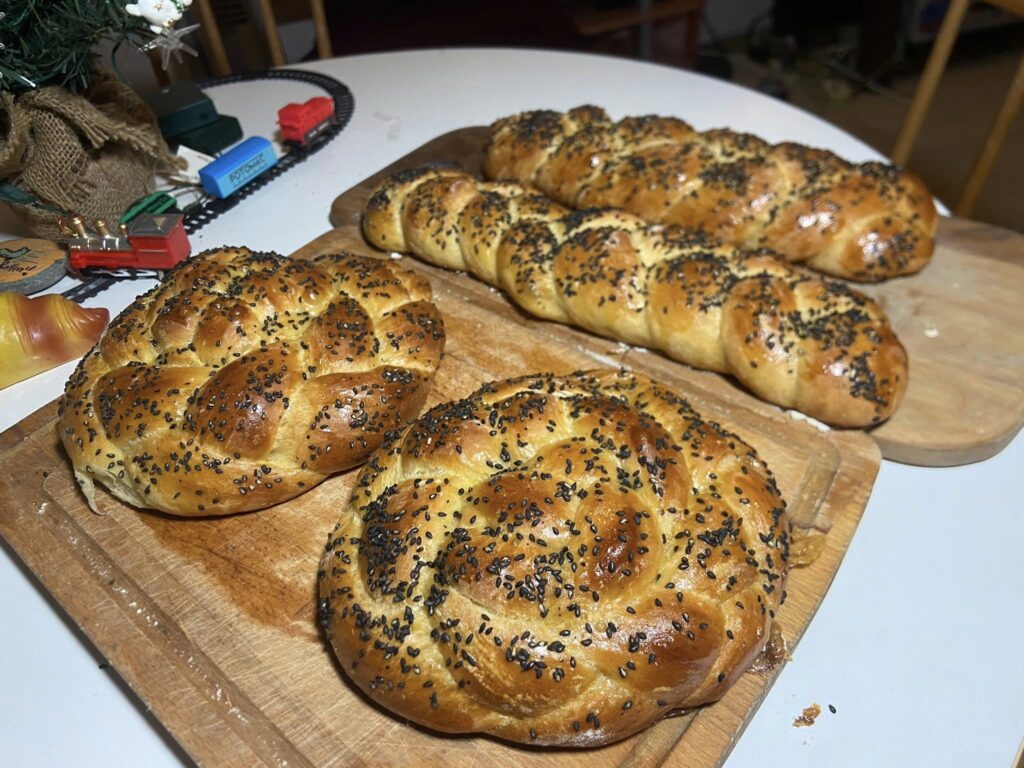
It’s pretty good. The lighting is a bit harsh. I’m not crazy about my braiding or the rise on these loaves. The crumbs on the side and the oily stain bother me.
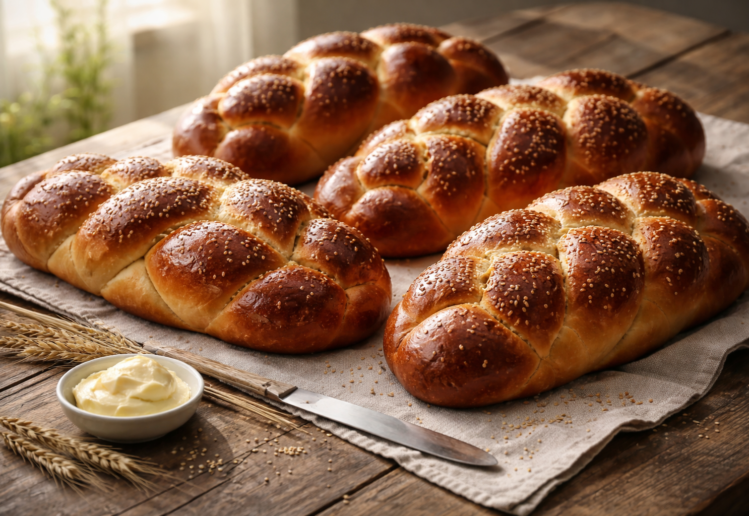
Here’s what ChatGPT produced for me just now, when I prompted it for a picture of four loaves of challah.
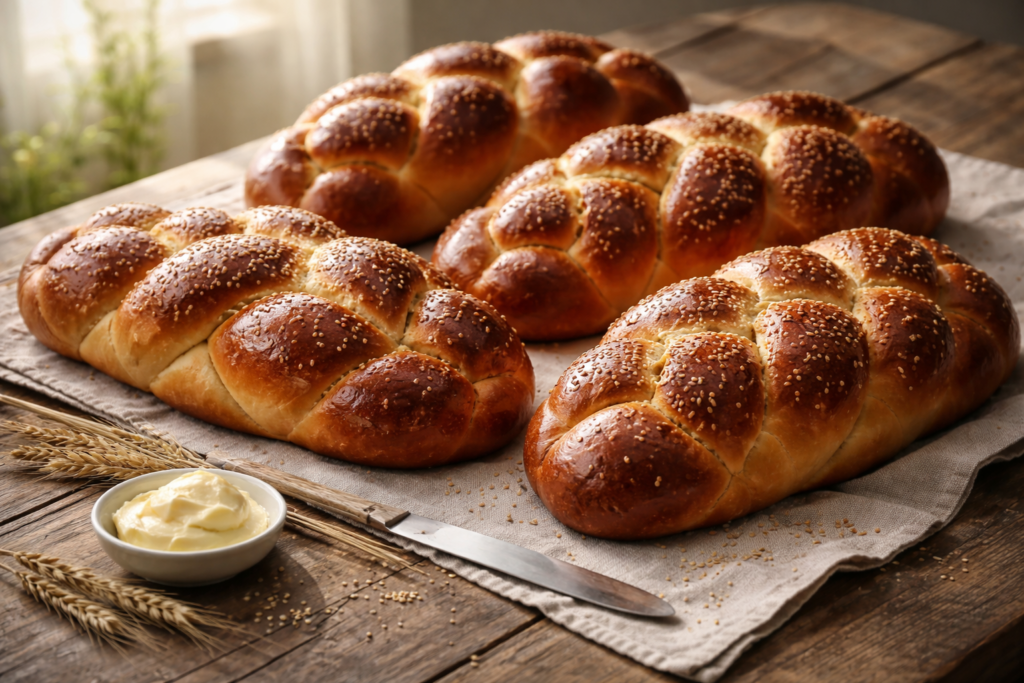
I mean, this is a stunning image. The light hits the bread just right, which has beautiful definition on each braid. The butter and the wheat are a nice touch.
So which one should I use?
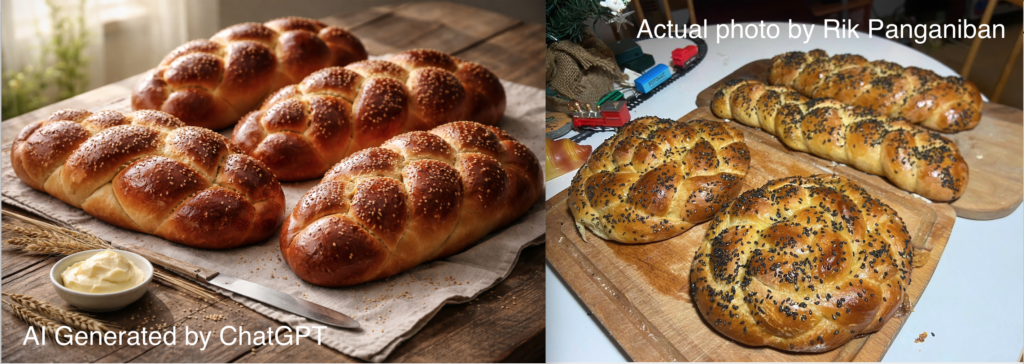
If we’re just talking the “best” picture, the AI one is clearly the one to use. It’s beautiful, well composed, more “professional.”
But if we are talking about me as a teacher connecting to my students, my actual photo is the right choice. Although it isn’t perfect, it’s real, and more importantly, it’s mine. It tells a story about me as a person, my interests and life outside the classroom.
So if I want to create a classroom environment where my students feel comfortable sharing about themselves, to be honest and vulnerable, I should model that.
Even better would be sharing this pic, which depicts me sharing one of the loaves with a friend.
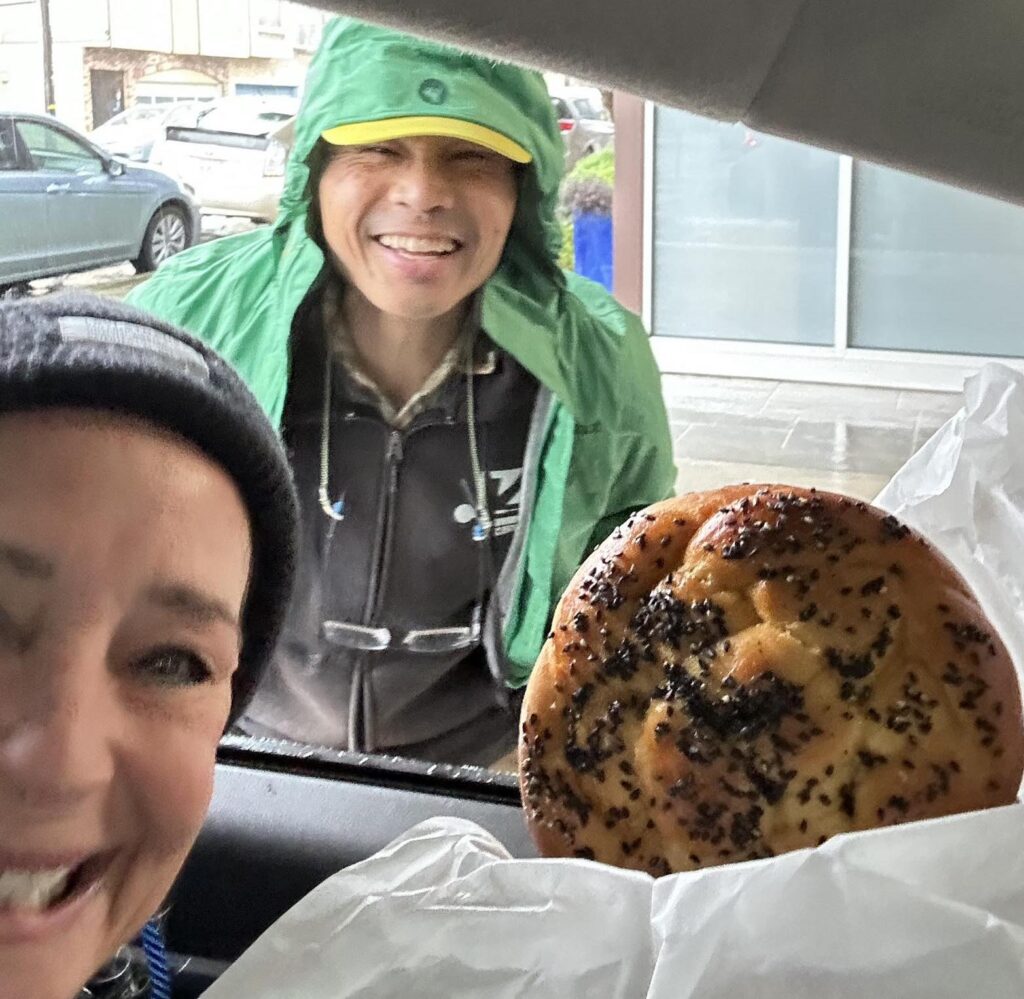
This is not to say that all AI generated images are bad or shouldn’t be used in your work. But just because it’s easier to generate a “perfect” image, doesn’t necessarily mean that this is the always the best choice.
It all depends on your objectives as a creator. If one of your goals is to make a human connection to someone else, then human created media, with all of its faults and flaws, is better than any algorithm.
COVER IMAGE: “Four loaves of challah bread” prompt, ChatGPT, Open AI, 29 January 2026. www.chatgpt.com