
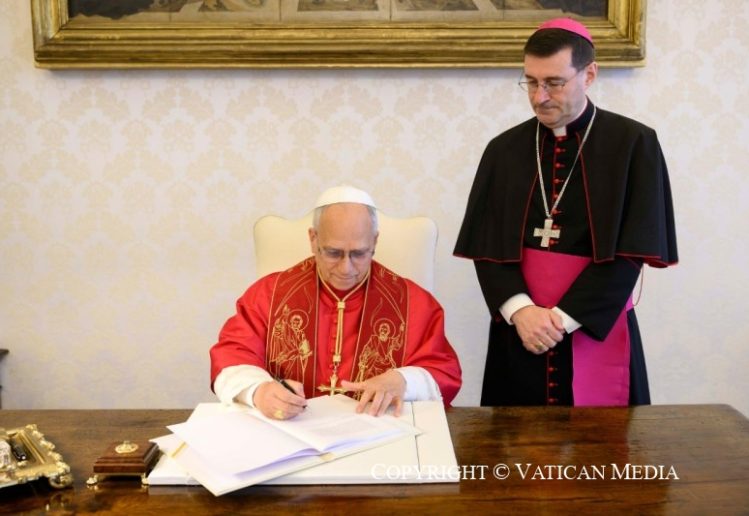
I finally had some time to review Pope Leo XIV’s official “encyclical” on the topic of artificial intelligence, which they published last month. While I have not read the whole thing (50+ pages of text) in detail, it raises a lot of important concerns about generative AI that are worth considering.
On what is “artificial intelligence.”
99. It is not possible to provide a single, comprehensive definition of AI. What can be stated, however, is that we must avoid the misconception of equating this type of “intelligence” with that of human beings. These systems merely imitate certain functions of human intelligence. In doing so, they often surpass human intelligence in speed and computational capacity, offering tangible benefits across many fields. Yet this power remains entirely tied to data processing. So-called artificial intelligences do not undergo experiences, do not possess a body, do not feel joy or pain, do not mature through relationships and do not know from within what love, work, friendship or responsibility mean. Nor do they have a moral conscience, since they do not judge good and evil, grasp the ultimate meaning of situations, or bear responsibility for consequences. They may imitate language, behavior and analytical skills, or even simulate empathy and understanding, but they do not understand what they produce, for they lack the affective, relational and spiritual perspective through which human beings grow in wisdom. Even when these tools are described as capable of “learning,” their way of doing so is different from that of a human person. It is not the experience of those who allow themselves to be shaped by life and grow over time through choices, mistakes, forgiveness and fidelity. Rather, it is a form of statistical adaptation based on data and feedback, which can be very effective, but does not imply inner growth.
On education:
139. In an era when truth is often distorted in order to serve particular interests and communication strategies, the field of education assumes decisive importance. Yet rapid technological transformations reveal just how unprepared we are on the educational level. The pervasiveness of digital media fosters a culture of immediacy and hyper-stimulation, which gives rise to fatigue, boredom and apathy concerning the effort required for seeking the truth.
140. Education, by contrast, is a long journey requiring patience, and therefore needs time for development and for engagement with reality beyond appearances. This is a fundamental issue because every technology shapes those who use it. Educating people about the use of AI, then, involves teaching them to decide when and for what purpose it ought not to be used. The speed and ease with which answers or summaries can be obtained risk extinguishing the desire to ask questions, which is a process that bears fruit only over time. As Plato wrote, the deepest and most important things are learned only after much time and effort, by engaging in discussion with others, “striking upon” ideas and experiences together like flint until the spark of understanding is kindled within us. [147] We must learn, then, how to exercise restraint in the use of AI and to protect our young people from the promise of the perfect machine, from that subtle temptation which renders human thought seemingly superfluous precisely when it is most needed.
On the need for continued development of teaching practices in light of technological changes:
145. The second major challenge is pedagogical. Many educational systems struggle to keep pace with change and to support the integral development of students. The advance of information technologies and AI is rapidly rendering curricula obsolete that were designed for a different era. Meanwhile, the organization of schools, physical spaces, evaluation methods and the role of teachers themselves must be rethought in order to promote an authentically integral education that addresses every dimension of the person. It is necessary to support the ongoing formation of teachers throughout their professional lives, so that they can engage positively with new technologies, helping students to use them responsibly, critically and creatively, rather than passively succumbing to their influence.
Pope Leo XIV also raises concerns about the impact of AI on jobs and livelihoods, the use of AI in warfare, and the concentration of power from AI in the hands of a handful of companies.
Overall a worthwhile read that I hope will lead to more public conversation and support for AI governance and oversight.